
Why Australia Marsupial Mole Defies Evolution Expectations
Evolutionary biology is full of surprises, but few creatures shatter our textbook classifications quite like subterranean desert dwellers.
Annonces
There is something deeply unsettling about an animal that dismantles our comfortable categories so thoroughly, forcing researchers to rethink how natural selection operates when an organism is pushed to extreme environmental margins.
At the center of this biological puzzle sits the Australia Marsupial Mole (Notoryctes)—or rather, two distinct species known locally as kakarratul and itjaritjari.
These elusive, soft-furred creatures navigate the shifting dune systems of Central and Western Australia, spending almost their entire existence submerged beneath arid sands.
What follows is an exploration of this unique creature, detailing its convergent traits, anatomical quirks, subterranean mechanics, and the evolutionary theories that attempt to make sense of its existence.
What Is the Australia Marsupial Mole and Why Is It Unique?
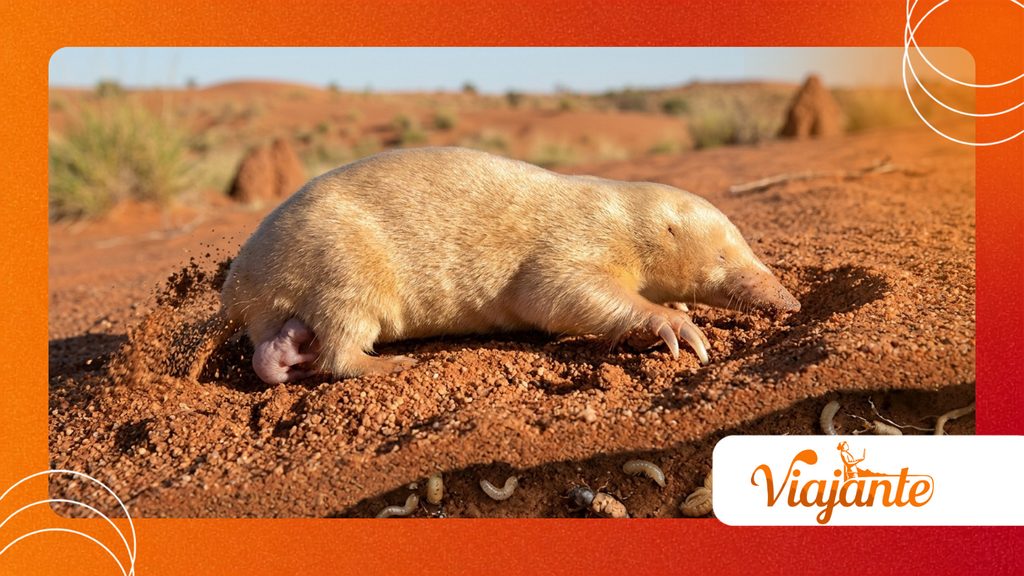
To encounter Notoryctes in evolutionary literature is to realize how radically adaptation can strip away the conventional mammalian blueprint. evolution essentially dismantled surface-level traits that offered zero return on investment in total darkness, leaving behind an creature streamlined for pure subterranean persistence.
Unlike standard placental moles familiar to the Northern Hemisphere, the Australia Marsupial Mole possesses no functional eyes, no external ear structures, and no visible tail. Instead, fused neck vertebrae give the animal the structural rigidity needed to push through heavy, compacted sand without crushing its own spine.
Taxonomists ended up placing these animals in their own distinct order, Notoryctemorphia. That isolated classification reflects tens of millions of years spent in complete lineage solitude within Australia’s harsh, nutrient-poor interior.
How Does Convergent Evolution Explain Its Remarkable Traits?
When two organisms share almost no recent common ancestry yet wind up looking like functional twins, evolutionary biologists point to convergent evolution.
Le Australia Marsupial Mole is perhaps one of the most stark examples of this process ever documented.
Place this marsupial next to a placental golden mole from Southern Africa, and the physical overlap is startling: spade-like claws, a conical body, and skin-covered vestigial eyes. Yet, genetically, these two lines parted ways over one hundred million years ago.
It turns out that physics imposes strict engineering limits on subterranean life. Desert sand demands a specific hydrodynamic shape, proving that distinct evolutionary lineages will eventually land on identical structural solutions when faced with the exact same physical constraints.
Evolutionary convergence reveals how unyielding physical environments—like dense sand or permanent underground darkness—relentlessly drive unrelated life toward the same mechanical designs.
Which Physical Adaptations Allow Underground Sand Swimming?
Standard moles dig permanent, reinforced tunnel networks that stay open for generations. Desert subterranean moles do something entirely different: they effectively “swim” through loose, fluid sand, allowing the substrate to collapse immediately behind them.
Their front limbs are equipped with two oversized, shovel-like claws on the third and fourth digits. These keratinized implements cut through loose soil with minimal drag, driving the animal forward through compressed earth.
A thick, horny nasal shield protects delicate snout tissue from continuous friction, acting like a battering ram against dense sand layers.
Combined with fused cervical vertebrae ($C2-C6$), the whole front of the body functions as a single, rigid digging piston.
For deeper research into how these traits are documented in museum archives, the Australian Museum Taxonomy Portaloffers extensive records detailing native species classifications and evolutionary histories.
Why Does Its Pouch Anatomy Defy Standard Biological Logic?
Marsupial reproduction relies on an abdominal pouch, which usually opens upward or forward so the young stay secure while the mother moves.
Kangaroos and koalas follow this familiar pattern without issue.
In a striking departure from standard marsupial design, the female Australia Marsupial Mole features a pouch that opens backward toward her hind legs.
It is an ingenious modification; a forward-facing pouch would act as an open scoop, filling with abrasive sand as she tunnels.
Without this inverted setup, fine desert grit would smother the developing young attached to her milk glands. It is a brilliant example of how natural selection can hijack a standard family trait and turn it inside out to solve an immediate mechanical crisis.
Because energy is notoriously scarce in arid dune fields, these females raise only one or two offspring at a time, keeping reproductive demands aligned with a unpredictable food supply.
++ Pourquoi les systèmes de naines brunes rares intriguent les astronomes aujourd'hui
What Are the Key Differences Between Marsupial and Placental Moles?
Comparing these two distant mammalian lines illustrates how separate evolutionary paths can arrive at nearly identical practical outcomes. The structural differences below highlight where lineage history diverges from shared functional demands.
| Feature / Trait | Australia Marsupial Mole (Notoryctes) | Northern Placental Mole (Talpa europaea) |
| Mammalian Lineage | Metatheria (Marsupial) | Eutheria (Placental) |
| Pouch Orientation | Backward-facing abdominal pouch | Absent (Internal uterine development) |
| Eye Structure | Completely vestigial, covered by skin | Reduced, functional light perception |
| Nasal Shield | Heavy keratinized cornified pad | Soft, highly sensitive tactile snout |
| Tunneling Style | Sand-swimming (No permanent tunnels) | Permanent underground burrow systems |
| Neck Anatomy | Fused cervical vertebrae ($C2-C6$) | Fully flexible standard vertebrae |
This comparison underscores how natural selection works with whatever raw genetic material it inherits, carving out parallel lifestyles from completely different evolutionary starting blocks.
++ La vérité sur les adaptations à l'oxygène souterrain chez les mammifères
How Does It Regulate Body Temperature in Arid Deserts?
Maintaining a constant, high body temperature requires a steady intake of calories—a luxury that barren desert ecosystems rarely guarantee. Typical mammals burn through energy reserves just to stay warm, but this subterranean specialist takes a far more flexible approach.
Rather than fighting external conditions, the Australia Marsupial Mole allows its internal temperature to fluctuate alongside the surrounding sand, displaying poikilothermic tendencies that drastically cut its daily caloric requirements.
This metabolic adaptability allows the creature to survive prolonged periods between meals. Running at a lower metabolic baseline also reduces oxygen consumption, a critical advantage when navigating deep, poorly ventilated sand layers.
Their diet consists mainly of subterranean insect larvae, ants, pupae, and root-dwelling invertebrates. Consuming these moisture-rich insects supplies all necessary fluids, freeing the animal from any need to seek out open surface water.
When Was It First Recognized by Modern Science?
Indigenous Australians held deep knowledge of these subterranean creatures for generations, tracking them across desert sands long before European naturalists arrived. Western science did not catch up until late in the nineteenth century.
In 1888, a pastoralist named William Coulthard collected a specimen near Idracowra Station in the Northern Territory. The finding reached Dr. Edward Stirling, who realized he was looking at an evolutionary marvel and published the first formal description.
Classifying the creature threw early taxonomists into confusion because its anatomy broke so many established rules. Scientists eventually had to erect an entirely new order, Notoryctemorphia, to give the animal a proper place in mammalian taxonomy.
Modern genomic analysis continues to shed light on this ancient lineage, with molecular clock studies suggesting their ancestors adapted to life under the sand tens of millions of years ago.
What Makes Their Conservation Monitoring so Challenging?

Studying an animal that leaves no permanent burrows and spends almost its entire life underground is a logistical nightmare for field biologists. Standard survey techniques like camera traps or footprint transects are virtually useless here.
To track them, conservationists rely heavily on environmental DNA (eDNA) extracted directly from desert sand. Sampling microscopic skin shed beneath the surface allows researchers to confirm their presence without tearing up fragile dune habitats.
Working alongside First Nations rangers has transformed this research, combining ancient tracking skills with modern molecular tools. This hybrid approach offers a far clearer picture of population health across vast, isolated desert stretches.
To explore broader conservation frameworks applying to rare desert fauna, consult the IUCN Red List Species Database for detailed environmental evaluations and regional status reports.
The Broader Biological Picture
Le Australia Marsupial Mole stands as a stark reminder that evolution is not a linear march toward complexity, but an opportunistic slide into whatever niche works.
By abandoning sight, structural flexibility, and standard mammalian thermoregulation, this creature carved out an undisturbed life beneath the Australian desert.
Understanding these specialized adaptations broadens our view of mammalian resilience, proving that life will find a way to thrive even when buried beneath feet of shifting sand.
++ Comment les indices fossiles martiens ont suscité la curiosité mondiale
Foire aux questions (FAQ)
What does the Australia Marsupial Mole eat?
Its diet centers on subterranean invertebrates, including ant larvae, beetle pupae, earthworms, and various soil-dwelling insects hunted beneath the sand.
Is the Australia Marsupial Mole completely blind?
Yes. The optic nerve is entirely vestigial, and the tiny remnant eye structures sit permanently hidden beneath thick, protective skin to keep out sharp sand grains.
How deep do these animals dig in desert dunes?
They move comfortably anywhere from a few inches below the surface down to depths exceeding two meters, shifting levels depending on ground temperature and where prey is concentrated.
Why does it leave no permanent underground tunnels behind?
Because loose desert sand collapses instantly as the animal moves through it, Notoryctes effectively “swims” through the earth rather than excavating open structural burrows.
\