
Le mystère des fossiles d'anciennes forêts tropicales dans les déserts
Kick away a layer of windblown sand in the middle of the Sahara, and you might find the stone imprint of a water-loving mangrove root.
Annonces
There is something deeply unsettling about holding a petrified fern frond in a place where rain has not fallen in a decade—a quiet reminder that our maps are temporary sketches.
Unraveling the Mystery Behind Ancient Rainforest Fossils in Deserts forces us to stop treating modern geography as a permanent fixture.
For centuries, travelers stumbled across stone logs in bone-dry badlands and invented myths about petrifying curses or biblical floods.
Today, paleobotanists read those same fossilized wood grains, leaf veins, and microscopic pollen shells like a bruised black-box flight recorder from Earth’s turbulent past.
What follows is not a dry catalog of rocks, but an investigation into how continents drift out of the rain, how orbital wobbles starve entire monsoons, and why dead jungles hold an uncomfortable mirror up to our current climate trajectory.
What Is the Mystery Behind Ancient Rainforest Fossils in Deserts?
We tend to look at a desert and assume it was always broken, barren, and hostile to life.
That assumption collapses the moment you step into northern Arizona’s Painted Desert, where twenty-foot logs of Araucarioxylon arizonicum lie scattered across sun-baked clay like fallen pillars of a forgotten cathedral.
These massive conifers did not sprout in an arid wasteland; they towered over a humid, river-braided Triassic floodplain roughly 225 million years ago.
Volcanic ash choked the valley, burying the timber in silica-rich mud that slowly swapped organic wood fibers for quartz crystals.
Looking at the Mystery Behind Ancient Rainforest Fossils in Deserts means accepting a humbling geological truth: during the Cretaceous and early Eocene epochs, Earth ran hot enough to sustain dense, dripping canopies at latitudes that now blister under relentless high-pressure sun.
How Do Plate Tectonics Move Rainforests Into Desert Zones?
Continents do not sit anchored in place; they ride restless slabs of lithosphere at roughly the speed your fingernails grow.
Give that sluggish crawl fifty million years, and an entire ecosystem gets dragged across planetary climate zones without ever asking permission.
Landmasses parked near the equator sit squarely beneath the Intertropical Convergence Zone, where warm, moisture-heavy air rises and dumps torrential rain almost daily.
As tectonic drift nudges a continent northward or southward toward thirty degrees latitude, the atmospheric plumbing flips completely.
Around those subtropical latitudes, high-altitude air cools, sinks, and compresses—sucking moisture out of the soil and suffocating cloud formation before it starts.
An equatorial jungle carried into that belt does not burn overnight; it slowly starves, leaving its mineralized roots buried beneath advancing dunes.
++ La vérité sur les adaptations à l'oxygène souterrain chez les mammifères
Which Famous Deserts Contain Documented Rainforest Fossils?
This phenomenon is hardly an isolated quirk of the American Southwest; field teams have pulled tropical relics from the world’s harshest sandscapes.
Each site tells a slightly different story of how water vanished from the land.
| Desert Location | Geological Epoch | Approximate Age | Documented Fossil Specimens | Primary Scientific Institution |
| Sahara Desert (Egypt) | Late Eocene | 37 Million Years | Mangrove roots, palm trunks, tropical seeds | Cairo University & Duke Lemur Center |
| Atacama Desert (Chile) | Crétacé supérieur | 70 Million Years | Broadleaf angiosperms, fern spores, palm wood | University of Chile Paleontology Lab |
| Painted Desert (USA) | Late Triassic | 225 Million Years | Araucarioxylon conifers, cycads, horsetails | National Park Service & USGS |
| Gobi Desert (Mongolia) | Early Cretaceous | 120 Million Years | Ginkgo leaves, dawn redwoods, aquatic ferns | American Museum of Natural History |
| Arabian Desert (Saudi Arabia) | Middle Miocene | 16 Million Years | Tropical fig leaves, wetland reeds, hardwood logs | Max Planck Institute for Geoanthropology |
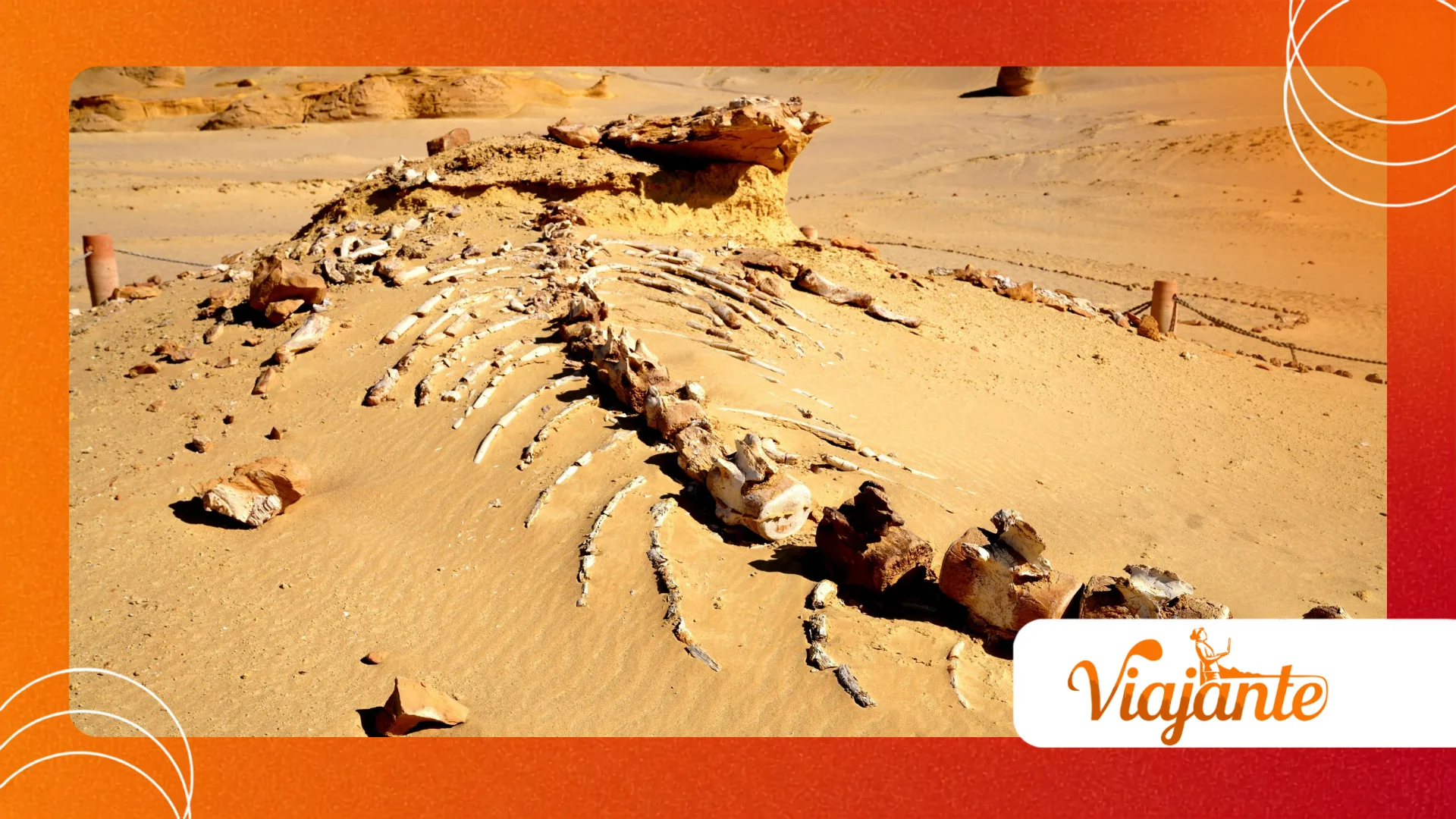
Take Egypt’s Wadi Al-Hitan, a valley famous for prehistoric whale skeletons baking in the Western Desert heat.
Just beyond those marine bones, researchers mapped fossilized mangrove swamps that once bordered the ancient Tethys Ocean before tectonic uplift drained the coastline dry.
Over in Chile, the hyper-arid Atacama holds Late Cretaceous broadleaf impressions that predate the Andes Mountains.
Once that colossal rock wall pushed skyward, it severed Pacific moisture winds, starving an entire canopy in a geological rain shadow.
++ Pourquoi la taupe marsupiale australienne défie les prédictions de l'évolution
Why Did Shifting Climate Cycles Turn Jungles Into Sand Dunes?
Slow-motion continental drift only explains half the puzzle; sometimes, a forest vanishes within a few thousand years because Earth’s orbit develops a slight wobble.
Known as Milankovitch cycles, these rhythmic shifts in axial tilt and orbital precession dictate how much summer sunlight hits the northern hemisphere.
Roughly ten thousand years ago, during the African Humid Period, stronger summer solar heating pulled the West African monsoon deep into the Sahara.
Hippos wallowed in Chadian mega-lakes, gallery forests shaded flowing rivers, and early human communities fished along green shorelines where only dunes survive today.
According to sediment core studies tracked by the Institut d'études géologiques des États-Unis, a subtle orbital shift weakened that monsoon engine around 5,500 years ago.
Within centuries, lakes evaporated, roots lost their grip on the topsoil, and the wind reclaimed the basin.
How Does Mineralization Preserve Delicate Rainforest Plants?
Rainforests are notoriously terrible places to become a fossil because warm, wet jungle floors are ruthless recycling machines.
A fallen tree in the Amazon gets stripped by beetles, digested by fungi, and rotted by bacteria long before it can turn to pierre.
To beat that biological shredder, a forest needs a sudden, catastrophic burial that cuts off oxygen immediately.
Flash floods thick with river silt, choking blankets of volcanic ash, or massive mudslides had to seal those trunks away from aerobic decomposers in a matter of days.
Once entombed in waterlogged, airless sediment, groundwater saturated with dissolved silica, calcite, or iron seeped into the microscopic cavities of the wood.
Molecule by molecule, mineral deposits cast the internal cell walls in stone, preserving delicate growth rings and stomatal pores across millions of years.
What Role Does Palynology Play in Solving Desert Fossil Mysteries?
Giant petrified logs make great photographs, yet the real smoking gun of the Mystery Behind Ancient Rainforest Fossils in Deserts is usually invisible to the naked eye.
Palynologists—scientists who hunt ancient pollen and spores—dissolve desert rock cores in hydrofluoric acid to isolate microscopic plant armor made of sporopollenin.
Every tropical plant family stamps its pollen grains with distinct geometric spikes, grooves, and pores that survive intact long after leaves crumble to dust.
Spotting palm, fig, or dipterocarp pollen under a scanning electron microscope removes any lingering doubt about what once grew above that barren basin.
Even better, counting pollen layers millimeter by millimeter reveals the exact tempo of ecological collapse.
You can literally watch moisture-craving ferns vanish from the record while drought-hardy scrub brush creeps in to take their place.
++ Comment la découverte des neurones lumineux a changé la recherche sur le cerveau
Why Do Desert Rainforest Fossils Matter for Modern Climate Science?
Digging up dead jungles is not merely an exercise in paleontological nostalgia; these rock layers act as stress-test receipts for our own atmosphere.
Every time we pump greenhouse gases into the sky, we nudge modern forests closer to thresholds they have already crossed in deep time.
Roughly 56 million years ago, during the Paleocene-Eocene Thermal Maximum, a massive surge of carbon spiked global temperatures by about five degrees Celsius.
Fossil leaf beds from that feverish window show rampant insect predation, stunted growth, and chaotic botanical migrations as forests scrambled to outrun the heat.
Ongoing paleobiology archives maintained by the Musée national d'histoire naturelle Smithsonian give climate modelers hard physical evidence rather than theoretical guesswork.
Those petrified trunks remind us that ecosystems do not bend infinitely—past a certain tipping point, they snap.
Réflexions finales
Revisiting the Mystery Behind Ancient Rainforest Fossils in Deserts strips away the comforting illusion that Earth’s landscapes are fixed in stone.
Tectonic plates wander, mountain ranges choke off rain clouds, orbital wobbles starve monsoons, and vibrant green worlds quietly turn to dust.
Yet those mineralized leaves and quartz-filled trunks refuse to let the story vanish completely.
Lying half-buried beneath desert glare, they remain stubborn proof that even the driest wilderness remembers the rain.
Foire aux questions (FAQ)
How old are the oldest rainforest fossils found in modern deserts?
Paleobotanists have recovered fossilized tropical scale trees and seed ferns dating back over 300 million years to the Carboniferous period.
Many of these specimens sit inside arid stretches of North America and North Africa that once formed steamy equatorial swamps.
Can petrified wood still contain original organic plant material?
Classic petrified wood undergoes complete permineralization, meaning quartz or calcite minerals replace every trace of original cellulose and lignin.
However, rare mummified wood discovered in hyper-arid salt flats or cold deserts occasionally preserves genuine ancient wood fibers.
Why are desert environments ideal for finding ancient fossils today?
Jungles hide their own geological history beneath thick topsoil, tangled roots, and aggressive chemical weathering from constant rain.
Deserts strip away that green curtain, letting relentless wind erosion peel back sedimentary rock layers and expose fossils right on the surface.
Did dinosaurs live inside these ancient desert rainforests?
Yes—Triassic and Cretaceous rock beds across the Gobi, Sahara, and Painted deserts routinely yield dinosaur skeletons alongside lush subtropical plant impressions.
Massive herbivores depended on those dense conifer canopies and fern thickets long before the climate dried out.
How do scientists determine the exact age of desert plant fossils?
Researchers rarely date the plant fossil itself because organic radiocarbon decays beyond detection after roughly 50,000 years.
Instead, geochemists measure uranium-lead or argon-argon isotope ratios inside volcanic ash layers sandwiched directly above and below the fossil bed.
\