
The Philadelphia Experiment: Did a Ship Really Disappear?

Was it a top-secret military breakthrough or a cleverly orchestrated hoax? The story of The Philadelphia Experiment has captivated minds for over 80 years.
Advertisements
This article dissects the enigma with a modern lens, exploring official documents, expert analyses, and public fascination.
You'll find insights into the origins of the theory, its scientific feasibility, the psychology of mass belief, and the cultural echo it leaves today.
Here's everything you need to know about one of the most persistent naval conspiracy legends of the 20th century.
A Brief Origin of the Mystery
In 1955, writer Morris K. Jessup received a series of letters from a mysterious man named Carl Allen (or Carlos Allende).
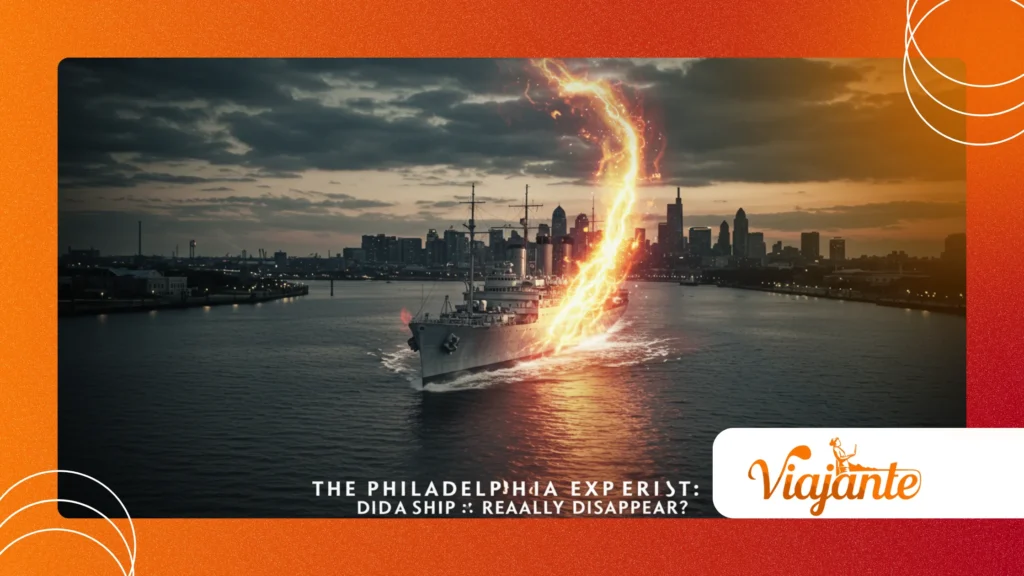
Allen claimed to have witnessed the US Navy rendering the USS Eldridge invisible at the Philadelphia Naval Shipyard in 1943.
The event apparently involved intense electromagnetic fields that made the ship not only disappear but also teleport to Norfolk, Virginia.
These letters became the first public documentation of what would later be known as The Philadelphia Experiment.
Interestingly, Allen's account didn't stop at invisibility. He described horrifying side effects—crew members apparently embedded into the ship's structure, others driven insane, and some even vanishing entirely.
These disturbing claims, presented without evidence, sowed deep fascination and fear. Could advanced science really have gone so far, so fast?
The story took a darker turn when Jessup's annotated copy of his own book, The Case for the UFO, was mysteriously republished by the Office of Naval Research with Allen's cryptic notes.
The legitimacy of the annotations remains debated, but the association with a military office only deepened public intrigue.
Also read: The Curious History of Animal Symbolism in Flags
Military Technology During WWII: Facts vs. Fiction
The 1940s were a period of intense technological innovation. Radar, sonar, and nuclear energy were transforming warfare.
The Navy's Project Rainbow, mentioned in conspiracy circles, is sometimes linked to cloaking technology.
However, no reliable military documentation supports the claim that any project had the capability to bend light or matter as described in The Philadelphia Experiment.
In reality, degaussing was a common practice used to reduce magnetic signatures and avoid mines—often misinterpreted by those outside military circles.
The confusion between technical terms and imagined possibilities opened the door for myths to take root.
When a complex procedure like degaussing was viewed by an untrained observer, it might easily be misperceived as something far more exotic.
Furthermore, the Allied focus during WWII was primarily on radar jamming, codebreaking, and nuclear development, not teleportation.
Documents declassified in the 1990s regarding electromagnetic research contain no mention of experimental invisibility or teleportation programs involving naval vessels.
It's also worth noting that the ship's construction timeline alone debunks parts of the narrative.
The USS Eldridge was commissioned in August 1943 and did not arrive in Philadelphia until after the alleged experiment date.
+ The Moon Landing Debate: Why Do People Still Question It?
What the USS Eldridge's Logbooks Actually Say
Official records of the USS Eldridge directly contradict the teleportation story.
According to the US Naval Historical Center, the ship was never in Philadelphia on the dates the experiment was said to occur.
It was in New York and later Bermuda during that period, with logbooks verified by naval historians.
In 1999, the Navy published a detailed rebuttal outlining timelines, coordinates, and communication records.
These verifiable details have done little to stop believers, although they've provided skeptics with hard ammunition. The full report, still publicly accessible, serves as a methodical dismantling of the conspiracy.
Further corroboration came from surviving crew members. In interviews over the decades, sailors who served aboard the Eldridge consistently reported nothing unusual occurring—certainly no teleportation, invisibility, or catastrophic physical distortions.
Still, believers argue that memories could be wiped or altered, a theory that shifts from skepticism into science fiction.
As psychologist Dr. Elizabeth Loftus has shown, memory is malleable, but widespread fabrication on this scale remains scientifically unsupported.
Why Some People Still Believe
Why do certain theories persist even when evidence disproves them? It's less about facts and more about feelings.
Humans are naturally drawn to mystery and the unexplained, particularly in contexts where power and secrecy collide.
The Cold War was especially heightened public imagination around classified science.
A 2023 Pew Research survey revealed that 48% of Americans believe in at least one government cover-up involving extraterrestrial or unexplained technologies.
That shows just how durable mistrust can be—and how stories like The Philadelphia Experiment find fertile ground.
Belief often serves an emotional function. It satisfies a psychological need for control, understanding, or rebellion.
In this context, the Eldridge story becomes more than a naval rumor; it becomes a metaphor for the unseen forces believed to shape society.
Conspiracy theories also thrive in echo chambers. When believers gather, they reinforce one another's views, share selective evidence, and dismiss counterpoints as propaganda.
Social media has amplified this effect exponentially.
+ The Denver Airport Murals: Hidden Symbolism or Coincidence?
The Science of Invisibility: What's Possible Today
While teleportation remains in the realm of science fiction, cloaking technology has made strides.
In 2006, researchers at Duke University developed a metamaterial capable of bending electromagnetic waves around small objects.
Yet, these advancements are limited to tiny scales and specific wavelengths—nowhere near what The Philadelphia Experiment would have required.
Even today, military-grade camouflage focuses on thermal and visual concealment, not complete disappearance.
Programs like the US Army's “adaptive camouflage” use sensors and digital projection to match environments, but they are a far cry from invisibility or teleportation.
Quantum physics does allow for particle teleportation in laboratory conditions, but applying those concepts to a ship-sized object violates known physical laws.
So far, science stands firmly on the side of impossibility when it comes to the Eldridge's supposed feat.
Pop Culture's Role in Perpetuating the Legend
The story took a dramatic leap when it inspired the 1984 film “The Philadelphia Experiment,” a sci-fi thriller loosely based on Allen's claims.
The film catapulted the legend into mainstream consciousness, mixing fiction with kernels of reality.
Similar to how Roswell became synonymous with alien conspiracy, the Eldridge found its place in conspiracy canon.
More recently, podcasts and YouTube documentaries have revived interest, targeting younger audiences.
The power of repetition—and the internet's ability to blur truth and fiction—continues to breathe new life into old stories.
This cultural resonance is no accident. According to the Journal of American Folklore, conspiracy narratives adapt and persist by attaching themselves to new media platforms and societal fears.
The Philadelphia Experiment, with its themes of government overreach and science gone awry, fits this pattern perfectly.
“Once a myth finds its platform, it becomes harder to extinguish than to debunk.” – Dr. Michael Barkun, professor emeritus at Syracuse University and expert in conspiracy culture.
The Broader Consequences of Belief
For many, believing in The Philadelphia Experiment is harmless fun. But unchecked belief can sometimes distort public understanding of science, history, and politics.
For instance, fictionalized accounts have been used to promote pseudoscientific theories, which in turn fuel distrust in legitimate institutions.
This pattern has been observed in anti-vaccine movements, flat-earth beliefs, and other modern conspiracies.
While the Eldridge story may seem quaint by comparison, its mechanisms of influence remain highly relevant.
An offhand comment by a naval contractor during a 1989 lecture—where he mentioned “invisibility” in the context of radar—sparked a wave of speculation and reinterpretation.
Within weeks, his words were linked to Reddit threads, blog posts, and YouTube videos claiming he had confirmed the myth. The reinterpretation of vague comments shows how myths evolve in real-time.
Psychological Roots of the Legend
At its core, the fascination with The Philadelphia Experiment taps into the same psychological instincts that fuel myth-making across cultures.
It combines forbidden knowledge, state secrets, and alleged cover-ups into a single irresistible narrative.
Like the alchemists of old trying to transmute lead into gold, believers are drawn to the idea that hidden forces manipulate reality itself.
These metaphors are powerful precisely because they speak to anxieties about control and autonomy in a complex world.
Stories like this one are not merely curiosities—they are reflections of who we are, what we fear, and how we process uncertainty. That's what makes them enduring, even when the facts say otherwise.
Timeline of Events: What Really Happened?
| Year | Event |
|---|---|
| 1943 | Alleged experiment date |
| 1955 | Carl Allen contacts Jessup |
| 1956 | Navy reproduces annotated copy of Jessup's book |
| 1979 | Charles Berlitz publishes book popularizing the story |
| 1984 | Release of “The Philadelphia Experiment” film |
| 1999 | Navy publishes official debunking statement |
The Verdict: Myth, Misunderstanding, or Manipulation?
Despite decades of debunking, The Philadelphia Experiment remains a cultural artifact. It speaks less to science and more to the enduring need for wonder, rebellion, and hidden truths.
It's a myth recharged by technology but rooted in very human emotions.
So, did a ship really disappear? Or have we just made it vanish in the sea of our collective imagination?
For a more technical exploration of electromagnetic invisibility research, visit Nature Photonics.
If you're interested in a detailed historical analysis of US naval operations and the official USS Eldridge logbooks, consult the Naval History and Heritage Command.
Frequently Asked Questions (FAQ)
Did the US Navy ever acknowledge the experiment?
No. The Navy has repeatedly denied that any such experiment took place and provided evidence that contradicts the claims.
Is there any scientific basis for teleportation or invisibility?
Not at the scale described. While small-scale quantum teleportation exists, it's purely informational and not applicable to physical objects like ships.
Who was Carl Allen, really?
Carl Allen (also known as Carlos Allende) was a merchant marine with a history of making elaborate, unverifiable claims. His credibility is widely questioned.
Why does this story persist?
Because it blends mystery, government secrecy, and fringe science—three ingredients that consistently captivate the public.
Where can I find credible sources on this topic?
Two excellent resources include Nature Photonics for cloaking science, and the Naval History and Heritage Command for factual naval records.
