
The Flat Earth Movement: A Deep Dive into an Enduring Enigma
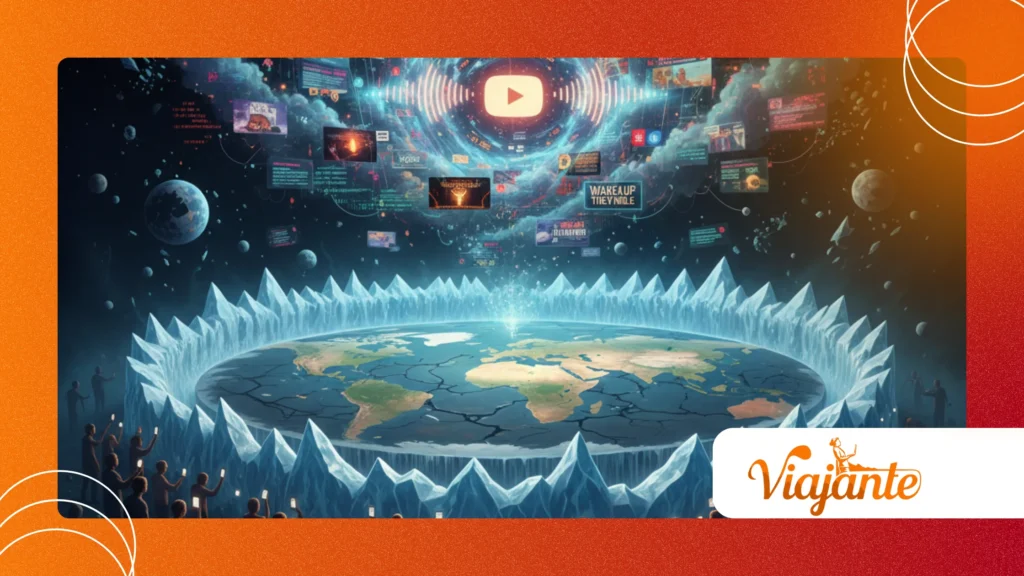
In an age defined by instant information and global connectivity, the resurgence of the flat earth movement This is a fascinating paradox.
Advertisements
While scientific consensus has long settled on a spherical planet, a vibrant community of “flat-earthers” continues to grow, attracting new followers and generating endless debate online.
This isn't just a quirky fringe belief; it's a social and psychological phenomenon that reveals deeper truths about trust, authority, and how we form our worldview in the 21st century.
So, why, in the face of overwhelming evidence, does the flat earth movement persist?
Table of Contents
- Introduction: The Enduring Mystery of the Flat Earth
- The Digital Echo Chamber: How Social Media Fuels the Movement
- The Appeal of the “Awakening”: A Community Built on Shared Revelation
- Empirical Evidence vs. Personal Experience: The “Seeing Is Believing” Fallacy
- The Role of Distrust: Questioning Authority and Mainstream Institutions
- Case Study: The Human Face of the Movement
- Expert Opinion: The Psychology Behind the Belief
- The Science of a Spherical Earth: A Brief Refresher
- Frequently Asked Questions
- Conclusion: A Glimpse into the Future of Misinformation
The Digital Echo Chamber: How Social Media Fuels the Movement
The modern flat earth movement isn't an academic or philosophical one; it's a digital one. The internet, particularly platforms like YouTube, has been its primary engine of growth.
Content creators publish videos claiming to “debunk” mainstream science, offering what they frame as “critical thinking” alternatives.
These videos often go viral, not because their arguments are sound, but because they are sensational and appeal to a sense of intellectual rebellion.
An analysis of YouTube's recommendation algorithm reveals how this happens.
Once a user watches one video about the flat earth, the algorithm suggests more and more related content, creating a self-reinforcing loop.
A casual viewer curious about a single video can quickly find themselves in a rabbit hole of content, each video building on the last, systematically dismantling their trust in mainstream sources.
This echo chamber insulates believers from outside criticism and creates a shared, alternative reality where their beliefs are constantly validated.
+ The Color of Absence: Why Some Languages Lack a Word for Blue
The Appeal of the “Awakening”: A Community Built on Shared Revelation
Beyond the simple mechanics of social media, the flat earth movement offers something deeply compelling: a sense of belonging and a narrative of personal enlightenment.
Many adherents speak of an “awakening” or “waking up” to a hidden truth. This narrative transforms them from ordinary individuals into enlightened truth-seekers, privy to a secret knowledge that the “sheeple” (mainstream society) are too blind to see.
This shared revelation fosters a strong sense of community. Members of the flat earth movement often feel ostracized by their families and friends for their beliefs, so they turn to online forums and conferences where they find acceptance and camaraderie.
This community provides emotional support and validates their worldview, making it incredibly difficult for them to abandon their beliefs, even in the face of contradictory evidence.
It's not just about the belief itself; it's about the identity and social connections that come with it.
+ Did the Government Create Wi-Fi to Spy on You?
Empirical Evidence vs. Personal Experience: The “Seeing Is Believing” Fallacy
One of the core tenets of the flat earth movement is the emphasis on personal, direct observation over established scientific theory.
Flat-earthers often challenge people with simple questions like, “Can you feel the earth spinning?” or “Can you see the curvature?”
While these questions seem intuitive, they rely on a fundamental misunderstanding of physics and scale.
For example, a common argument is that if the earth were a sphere, a level across a large body of water should show a curve.
This has been tested countless times, but the scale is so vast that any curvature over a short distance is imperceptible to the naked eye.
In a world where we can't personally verify complex scientific phenomena like the Coriolis effect or gravitational lensing, we rely on the collective knowledge and tools developed by scientists over centuries.
The flat earth movement rejects this reliance, creating a simplified, almost pre-scientific framework where “seeing is believing” is the only valid form of truth.
+ The Philadelphia Experiment: Did a Ship Really Disappear?
The Role of Distrust: Questioning Authority and Mainstream Institutions
At its heart, the flat earth movement is not a scientific debate—it's a crisis of trust. Many believers are deeply skeptical of government agencies, academic institutions, and even NASA.
They view these organizations not as sources of knowledge, but as conspiratorial entities engaged in a massive, decades-long deception.
The narrative often suggests that the “round earth lie” is a tool of control, designed to make people feel insignificant and powerless.
This distrust isn't random. It often stems from a broader disillusionment with authority figures.
Whether it's political corruption, economic inequality, or a general feeling of being left behind, many people feel that the “system” is rigged against them.
The flat earth theory provides a clear, tangible explanation for this feeling: The entire system is built on a lie.
By rejecting this fundamental “truth,” adherents feel they are taking back control and exposing a global conspiracy. This feeling of empowerment is a powerful motivator, far stronger than any logical argument.
Case Study: The Human Face of the Movement
To truly understand the flat earth movement, we need to move beyond the abstract and look at the people involved.
Take, for example, a conversation with a flat-earther named John (name changed for privacy), a former engineer who became a vocal proponent of the theory.
John's journey began after he lost his job in a corporate restructuring and felt increasingly alienated.
He stumbled upon a YouTube video and, feeling a void, began to explore. He wasn't a conspiracy theorist by nature; he was a man who felt his life had lost its purpose and was searching for answers.
The flat earth community offered him a new one.
“It wasn't about the shape of the earth at first,” he explained. “It was about the questions.
Why were we telling this? Why do we just accept things without asking? It made me feel like I was thinking for myself for the first time.”
John found a new purpose in creating content and engaging in debates. He became an authority within his new community, something he had lost in his old life.
This case highlights a crucial point: For many, the belief is a symptom of a deeper need for community, purpose, and a sense of control in a world that feels increasingly unpredictable.
Expert Opinion: The Psychology Behind the Belief
Dr. Maria Lopez, a social psychologist specializing in misinformation, sheds light on the psychological underpinnings of the flat earth movement.
“It's not about being uneducated,” she explains. “We see people from all walks of life—engineers, artists, teachers.
The common thread is often a combination of distrust, a search for meaning, and a deep-seated need for personal autonomy.”
She notes that a key psychological factor is cognitive dissonance. “When a person's core beliefs are challenged, it creates a deeply uncomfortable feeling,” she says.
“To avoid this discomfort, the brain will go to great lengths to find a way to make the new information fit their existing worldview.
In the case of flat-earthers, this means reinterpreting evidence, dismissing it as a hoax, or creating elaborate conspiracy theories to protect the core belief.”
Dr. Lopez emphasizes that confronting a flat-earther with facts rarely works. “It's like attacking their identity,” she says.
"The belief is tied to their community and their sense of self. The most effective approach is to address the underlying psychological needs—to rebuild trust, offer genuine community, and provide a sense of purpose."
The Science of a Spherical Earth: A Brief Refresher
While it may seem redundant, it's worth revisiting some of the basic, undeniable proofs of a spherical Earth, if only to highlight the chasm between scientific consensus and personal conviction.
- Circumnavigation: People have been flying, sailing, and walking around the globe for centuries. Ferdinand Magellan's expedition was the first to circumnavigate the Earth, proving it was a closed loop, not a flat plane with an edge.
- Time Zones: The existence of time zones is a direct result of the Earth rotating on its axis. As one part of the world enters day, another part enters night. On a flat earth, the sun would illuminate the entire surface simultaneously.
- Lunar Eclipses: During a lunar eclipse, the Earth passes between the Sun and the Moon, and the Earth's shadow is cast upon the Moon. This shadow is always circular, regardless of the time of day or year. The only shape that consistently casts a round shadow from any angle is a sphere.
- The Coriolis Effect: This effect, a result of the Earth's rotation, is what causes hurricanes in the Northern Hemisphere to spin counter-clockwise and in the Southern Hemisphere to spin clockwise. This effect is a cornerstone of modern meteorology and is directly observable.
- Gravity: The force of gravity pulls objects towards the center of a mass. On a spherical Earth, this means gravity pulls everything towards the core, which is why objects on opposite sides of the globe remain on the surface. On a flat plane, gravity would pull everything towards the center, causing water to pool and objects near the “edge” to be pulled inward.
Frequently Asked Questions
1. Is the flat earth movement a recent phenomenon?
While the modern movement has gained traction with the internet, the idea of a flat earth is an ancient one. Most ancient civilizations believed in a flat earth before philosophers like the Greeks proved otherwise. What's new is the scale of the movement and its ability to spread globally through digital networks.
2. Are flat-earthers serious, or is it a big troll/hoax?
While there are undoubtedly some who engage in the movement for humor or as a form of trolling, the vast majority of adherents genuinely believe in the flat earth theory. Their commitment to the belief is often a central part of their identity.
3. What is the “Ice Wall”?
In many flat earth models, the edge of the world is not a cliff but an “ice wall.” This is often a reimagined Antarctica, which they believe surrounds the entire disc-shaped Earth. This “wall” is often a source of great curiosity and debate within the community, with some believing it is patrolled by a secret organization to prevent anyone from going over the edge.
4. How can I talk to someone who believes in a flat earth?
Approaching the conversation with empathy and curiosity is key. Instead of trying to “win” a debate with facts, try to understand why they believe what they do. Asking open-ended questions like, “What made you start looking into this?” can help uncover the deeper motivations behind the belief, which may not be about the shape of the Earth at all.
Conclusion: A Glimpse into the Future of Misinformation
The persistence of the flat earth movement isn't just a testament to the power of a fringe idea; it's a stark reminder of the challenges we face in a hyper-connected world.
It reveals how easily trust in institutions can erode, how online communities can become insular echo chambers, and how powerful a sense of shared revelation can be.
The movement won't go away until we address the deeper issues that fuel it: the pervasive distrust of authority, the search for meaning and purpose, and the psychological need for community.
As long as these needs go unmet, people will continue to find comfort in alternative narratives, no matter how contrary to evidence they may be.
The flat earth movement is a symptom of a much larger crisis—a crisis of trust and a struggle for truth in a world overflowing with information and misinformation.
\