
شرح استراتيجية الصيد المذهلة لجمبري السرعوف
Beneath tropical coral reefs sits a crustacean capable of delivering one of the fastest biological strikes ever recorded.
إعلانات
Looking closely at the Amazing Hunting Strategy of Mantis Shrimp Explained reveals something almost unsettling about evolutionary engineering: a palm-sized reef dweller operating with ballistic precision.
Marine biologists generally divide stomatopods into two camps based on their raptorial appendages—smashers and spearers.
On paper, that sounds like a neat textbook division.
Out on the reef, though, each group runs a completely different playbook, storing elastic tension in its shell to turn physics against unsuspecting prey before a muscle twitch can even register.
What follows is a closer look at how these animals load mechanical springs, weaponize collapsing water bubbles, read light channels humans cannot imagine, and shift tactics across changing reef terrain.
جدول المحتويات
- What Is the Core Hunting Mechanism of a Mantis Shrimp?
- How Do Smashers and Spearers Differ in Predatory Tactics?
- Why Are Cavitation Bubbles Crucial to Their Strike Force?
- How Does Mantis Shrimp Vision Guide Target Acquisition?
- Which Prey Species Do Different Stomatopods Target?
- When Do Mantis Shrimp Ambush Versus Actively Forage?
- الأسئلة الشائعة
What Is the Core Hunting Mechanism of a Mantis Shrimp?
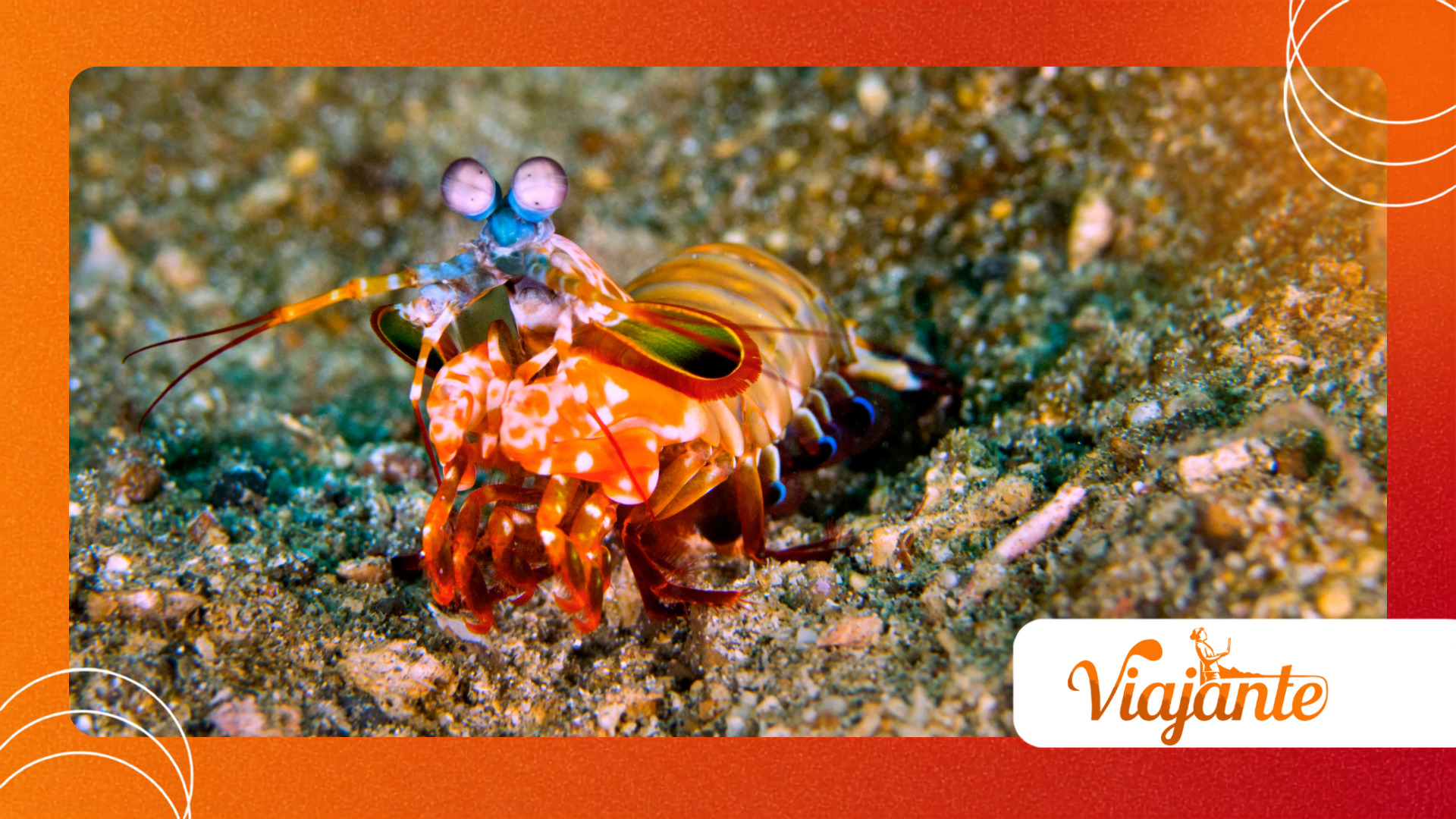
Muscle tissue alone simply cannot fire fast enough to explain what happens when a mantis shrimp strikes. Water creates brutal drag, and standard biological fibers hit a speed ceiling long before reaching ballistic velocity.
So stomatopods bypass muscular limits altogether, relying on an internal crossbow built straight into their exoskeleton.Curved, saddle-shaped structures compress slowly while a rigid latch holds the limb locked back.
Tension builds quietly—almost patiently—until that biological catch slips and dumps stored elastic energy into a single violent release.
Work from the Patek Lab at Duke University has spent years mapping this latch-mediated spring actuation, showing how miniature biomechanical latches outperform pure muscle mass across the animal kingdom.
During peak acceleration, the dactyl heel surges at up to 10,400 $g$, slicing through seawater faster than 23 meters per second.
Seeing the Amazing Hunting Strategy of Mantis Shrimp Explained through this mechanical lens changes how you view reef predators: raw size stops mattering once leverage takes over.
++ كيف يصطاد طائر أبو مركوب بدقة مذهلة
How Do Smashers and Spearers Differ in Predatory Tactics?
Over 450 stomatopod species roam Earth’s oceans, yet evolution pushed virtually all of them toward one of two specialized blueprints.
Both rely on spring-loaded limbs, sure, but their weapon geometry reflects an ancient arms race against very different defenses.
Smasher Hunting Execution:
- Smashers carry heavy, calcified dactyl clubs reinforced with shock-absorbing hydroxyapatite crystals arranged in spiraling micro-layers.
- Rather than hiding far off, they close the distance on armored prey and deliver percussive, hammer-like blows meant to fracture thick calcium carbonate.
- A stubborn snail or crab rarely survives the sequence; repeated strikes systematically crack its fortress open until soft tissue lies exposed.
Spearer Hunting Execution:
- Spearers trade the club for elongated, barbed blades lined with inward-facing spines built to snag soft, slippery flesh.
- Buried up to their eyes in sand or silt, they wait in total stillness—sometimes for hours—letting currents erase any sign of an ambush.
- Once a fish drifts within range, the predator erupts upward, unfolding those spiked limbs to hook and drag the target underground in one fluid motion.
| Predatory Feature | Smasher Stomatopods (e.g., Odontodactylus scyllarus) | Spearer Stomatopods (e.g., Lysiosquillina maculata) |
| Primary Weapon | Calcified dactyl club | Barbed, spine-lined raptorial claw |
| Typical Habitat | Coral reef crevices and rubble | Sandy or muddy seafloor burrows |
| Hunting Mode | Active foraging and close-range assault | Stationary sit-and-wait ambush |
| Target Prey | Crabs, snails, clams, rock oysters | Fast-swimming fish, shrimp, polychaete worms |
| Strike Duration | Approximately 2.7 milliseconds | Approximately 5 to 10 milliseconds |
Why Are Cavitation Bubbles Crucial to Their Strike Force?
Moving that fast underwater triggers a strange quirk of fluid physics—one that works entirely in the shrimp’s favor. As the club whips forward, water cannot rush in fast enough to fill the space behind it, causing local pressure to plummet.
Water briefly boils into microscopic vapor pockets between the club and the target shell. Microseconds later, surrounding ocean pressure slams those cavitation bubbles shut with devastating violence.
Acoustic sensors show that collapsing vapor pockets unleash a secondary shockwave packing roughly 1,500 newtons of force.
There is something almost unfair about that double tap: even when a smasher slightly misses its physical blow, the shockwave alone often stuns or kills the prey outright.
Stranger still, those imploding bubbles emit tiny flashes of light—a phenomenon physicists call sonoluminescence—alongside brief spikes of intense heat.
Unpacking the Amazing Hunting Strategy of Mantis Shrimp Explained reveals a predator that essentially weaponizes seawater itself.
++ الحياة السرية لأسماك القرش المتشمسة: ما وراء أسبوع أسماك القرش
How Does Mantis Shrimp Vision Guide Target Acquisition?
Firing a bullet-speed limb means nothing if your aim is off by a millimeter.
Mantis shrimp solve targeting with stalked compound eyes that move independently, each one capable of trinocular depth perception on its own.
Three separate regions inside a single eye lock onto the exact same point in space simultaneously. Unlike humans, who need two eyes working together to judge distance, a stomatopod measures range with just one.
People often assume their twelve to sixteen photoreceptor types mean mantis shrimp see a psychedelic rainbow invisible to us.
That assumption usually misses the real evolutionary point: instead of slowly blending colors in the brain, their eyes scan light channels like a barcode reader for instant target recognition.
Sensitivity to polarized light cuts straight through underwater glare, exposing transparent shrimp and reflective fish scales against busy coral backdrops.
Fast visual filtering keeps the predator from wasting energy on phantom targets.
Which Prey Species Do Different Stomatopods Target?
What ends up on the menu depends heavily on neighborhood architecture. Smashers thrive in crowded coral rubble where hard-shelled invertebrates graze across limestone ledges.
Peacock mantis shrimp routinely dismantle hermit crabs, thick-walled turban snails, and stubborn clams.
Younger individuals start out hunting softer amphipods, gradually graduating to heavily armored mollusks as their clubs thicken and mineralize over successive molts.
Out on open sand flats, where shelled prey become scarce, giant zebra mantis shrimp dig deep U-shaped tunnels instead.
Striking upward from beneath the sediment lets spearers pick off passing damselfish, cardinalfish, and migrating shrimp before they ever sense movement below.
Detailed taxonomic records and specimen archives maintained by the المتحف الوطني للتاريخ الطبيعي التابع لمؤسسة سميثسونيان illustrate just how tightly appendage shape tracks prey availability across global reefs.
When Do Mantis Shrimp Ambush Versus Actively Forage?
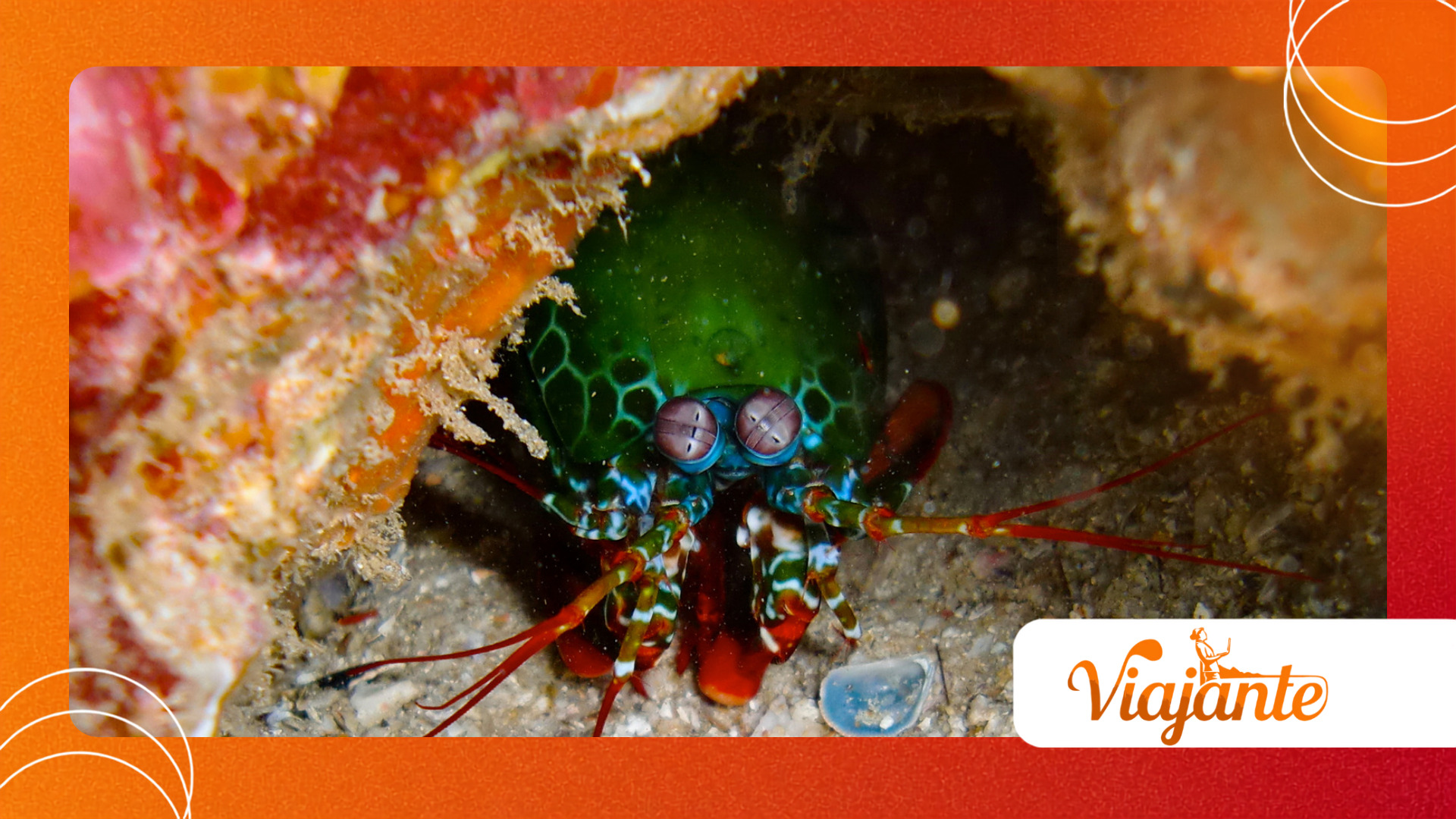
Light levels and shifting tides quietly govern when these hunters leave cover.
Daylight favors smashers like Odontodactylus scyllarus, which patrol reef crevices actively hunting concealed snails and crustaceans.
Once a smasher cracks a shell open, it rarely lingers in the open; most drag their prize straight back into a fortified burrow to eat away from moray eels, octopuses, and hungry triggerfish.
Spearers play a slower game, leaning heavily into dusk and nighttime windows when nocturnal fish cruise low over the seabed.
Staying tucked inside a burrow burns almost no calories while keeping soft bodies hidden from open-water predators.
Stepping back to look at the Amazing Hunting Strategy of Mantis Shrimp Explained, what stands out most isn’t any single anatomical trick—it is how seamlessly mechanical power, fluid dynamics, and ruthless patience lock together in one compact hunter.
++ المهارات الخفية لطيور السكرتير في صيد الثعابين السامة
الأسئلة الشائعة
How hard can a mantis shrimp punch?
A full-grown peacock mantis shrimp generates around 1,500 newtons of impact force—comparable to the muzzle velocity of a .22-caliber bullet hitting at point-blank range.
Can a mantis shrimp break aquarium glass?
Large smashers have cracked standard glass tanks when startled near the walls, which is why experienced marine aquarists house them in thick acrylic setups.
Do mantis shrimp eat their prey alive?
Smashers almost always stun or kill prey immediately through blunt impact and cavitation shockwaves, while spearers impale and pin fish securely before feeding.
How fast does a mantis shrimp strike?
Smasher clubs accelerate past 10,000 $g$, reaching top speeds near 23 meters per second in under three milliseconds—roughly fifty times faster than a human blink.
Why do mantis shrimp have so many color receptors?
Rather than creating richer color blends, sixteen specialized photoreceptors process color and polarized light directly at the eye level, speeding up split-second decisions during hunts and territorial standoffs.
\